Launch offer — valid today only

📄 Digital book in PDF · read it on your phone or print it

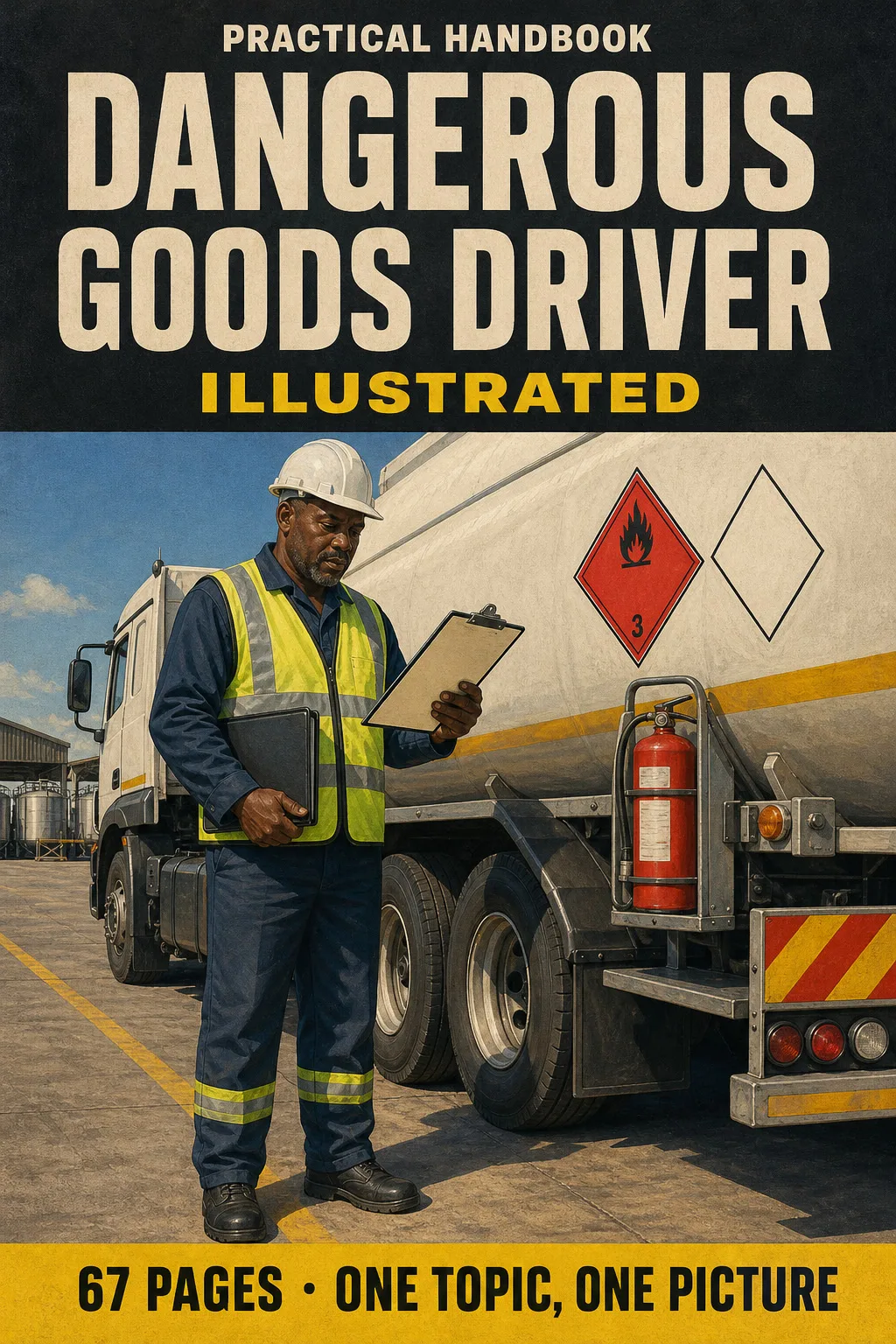
PrDP Dangerous Goods in Drawings: Read Placards, Tremcards and Spill Steps in the Same Order Every Time One Topic on Every Page

For South African drivers: the 9 classes, UN numbers, hazard diamonds, vehicle placards, the Tremcard, tanker loading, segregation and the spill steps. Every topic has its own page: the drawing first, then what you need to remember. 67 illustrated pages.

START STUDYING THIS WAY

🔒 Secure checkout · PDF by email · 30-day guarantee

Every topic, its own pageEach class, placard and procedure drawn, with the explanation beside it
67 illustrated pages9 parts, from what counts as dangerous goods to the revision cards for the cab
Up-to-date sourcesNational Road Traffic Regulations and SANS 10228, 10231 and 10232
PDF by emailFormat

Look Inside the Book

Every page has one large drawing and a box with the numbers and steps you need to know:

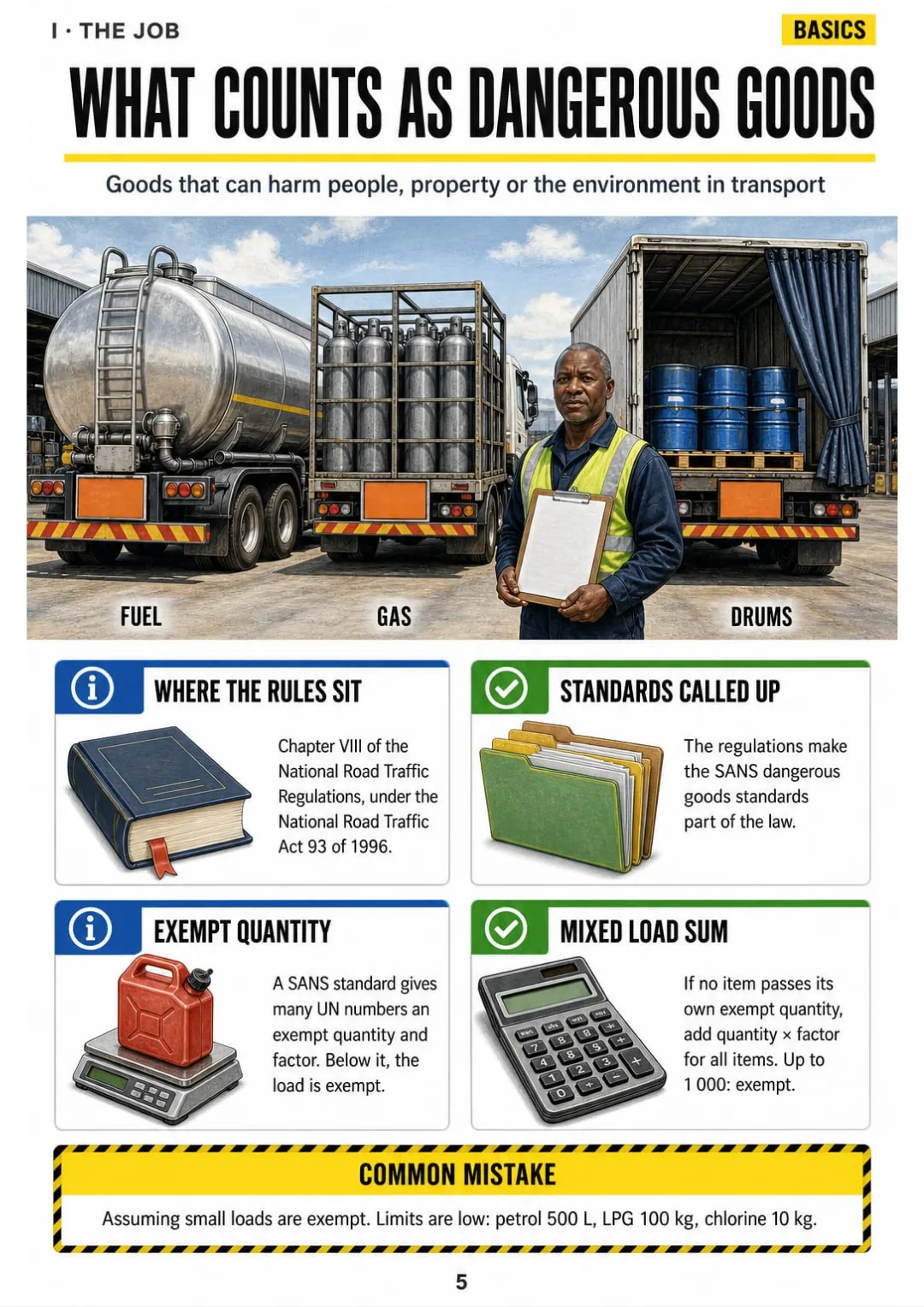
Exempt quantity per UN number: quantity × factor, summed, up to 1 000
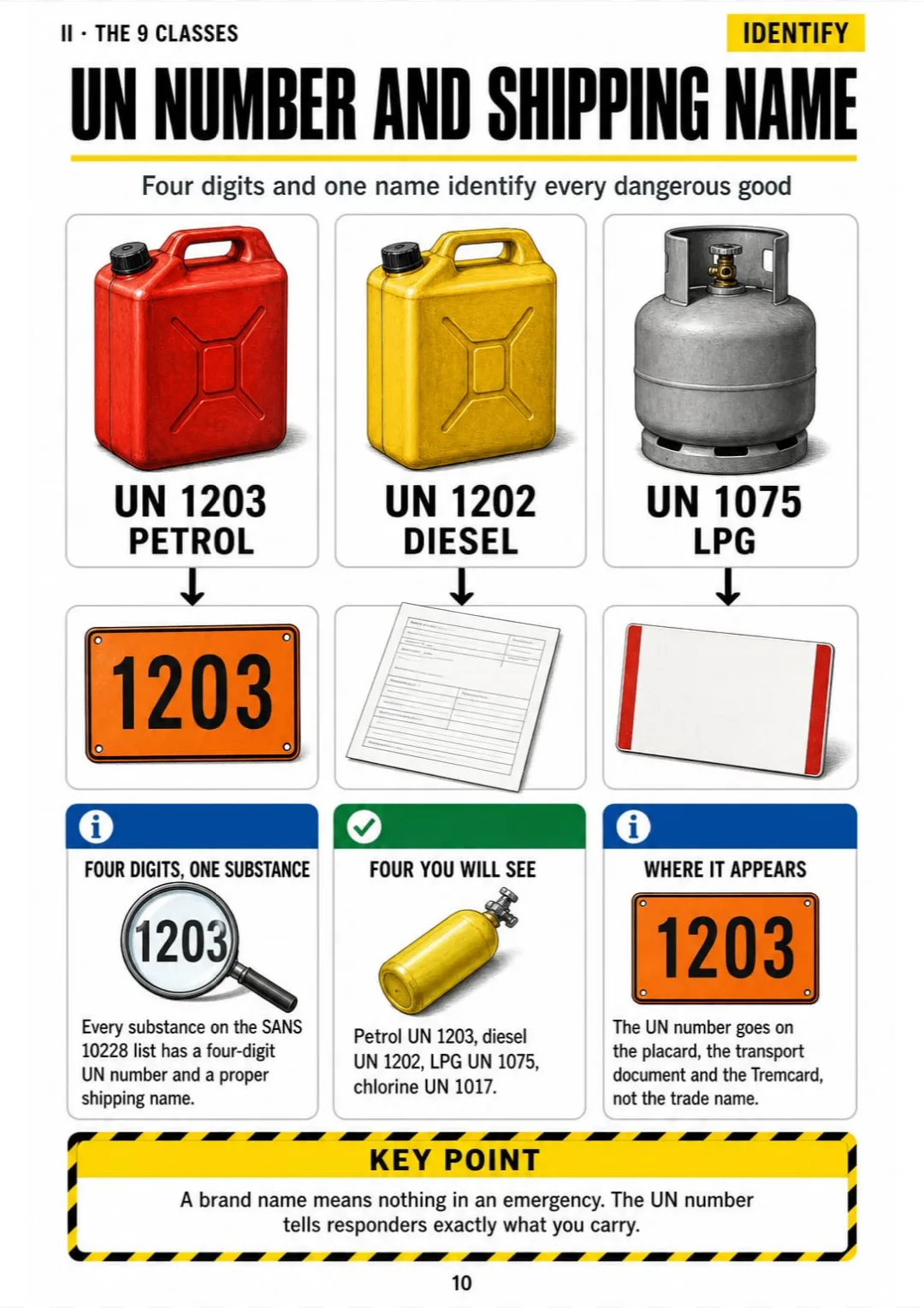
Petrol UN 1203, diesel UN 1202, LPG UN 1075: the number that goes on every document
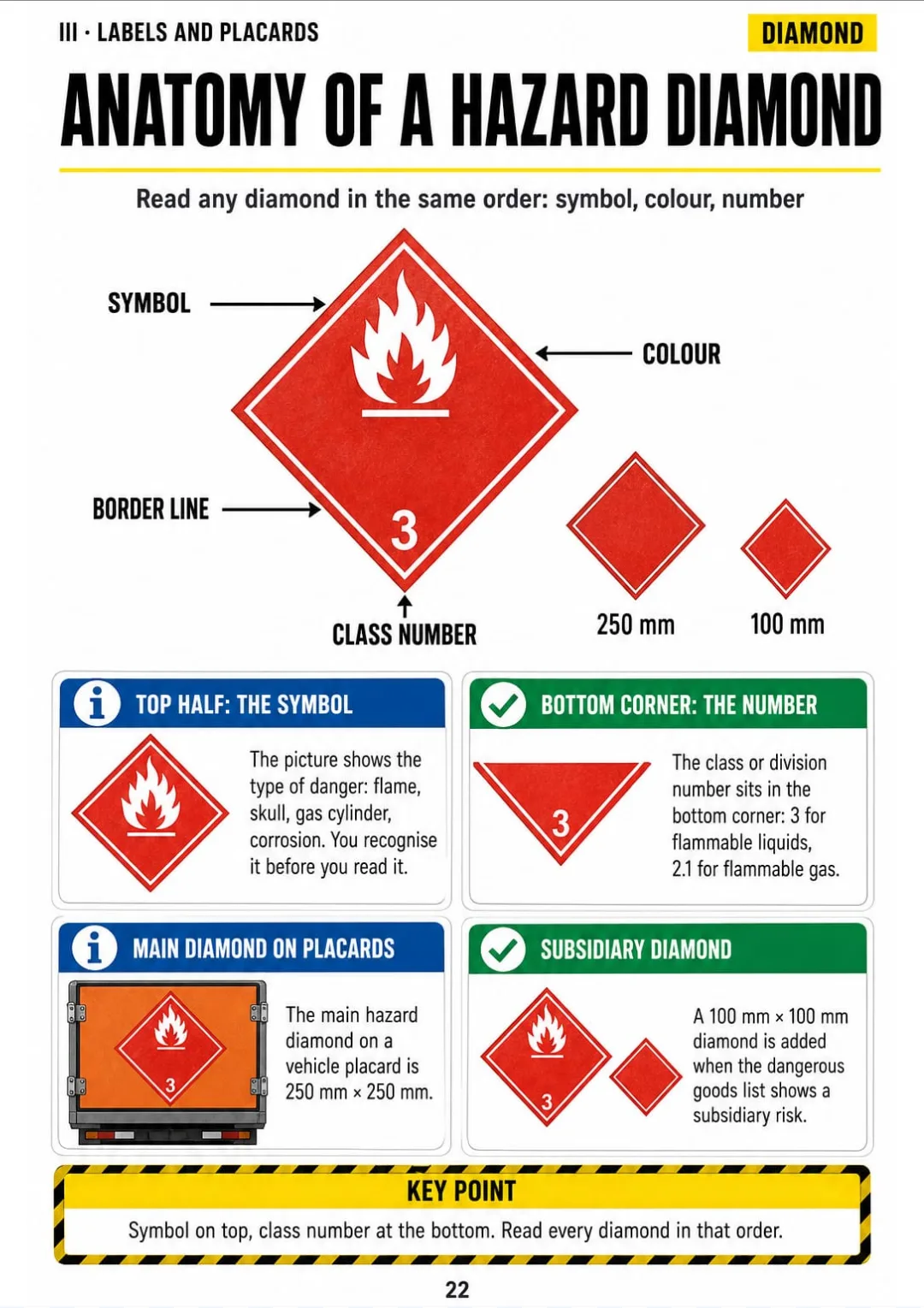
Main hazard diamond 250 mm, subsidiary diamond 100 mm, class number in the bottom corner.
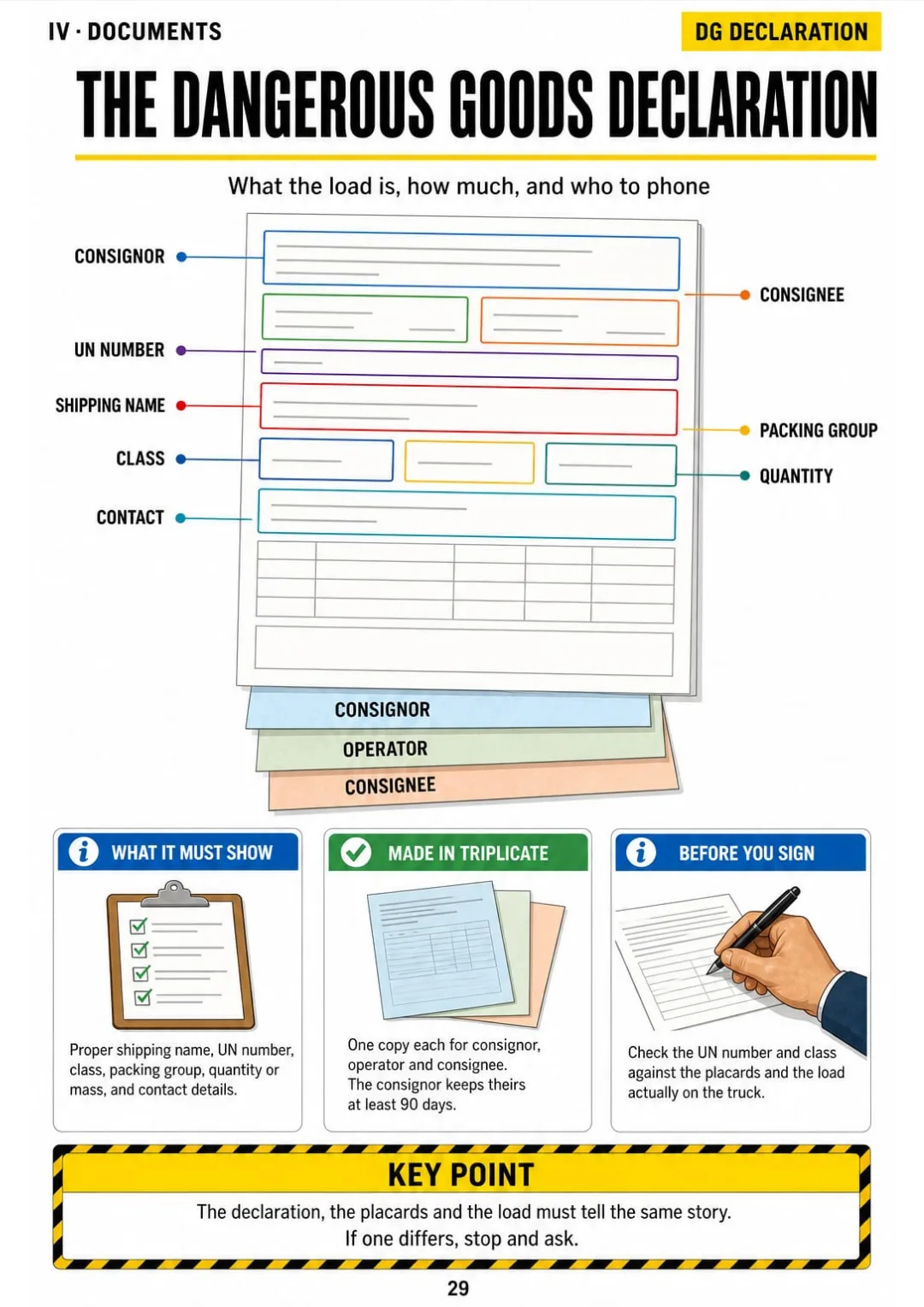
DG declaration: shipping name, UN number, class, packing group, quantity, contacts, made in triplicate
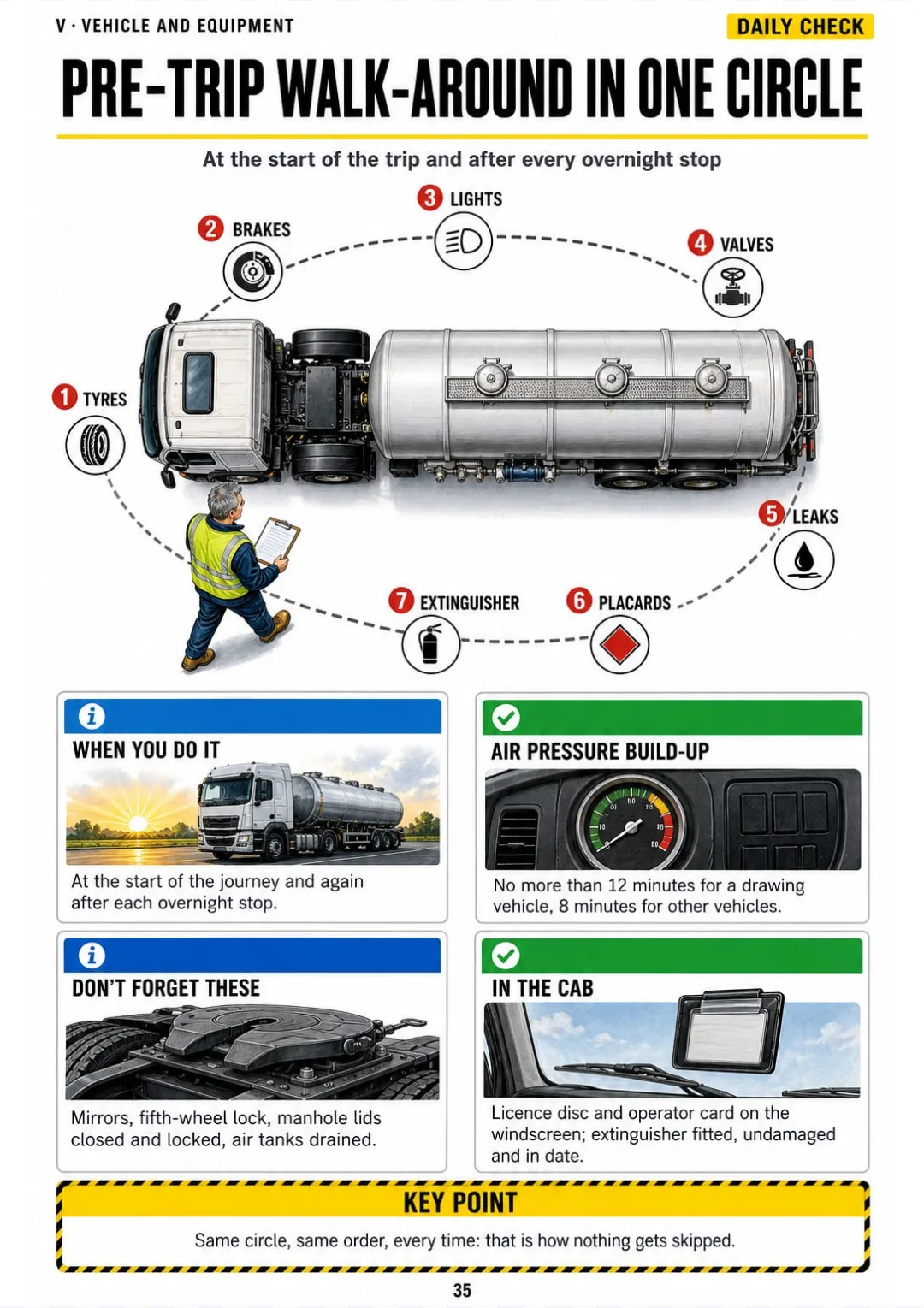
Daily walk-around: start of the trip and after each overnight stop; air build-up max 12 minutes for a drawing vehicle.
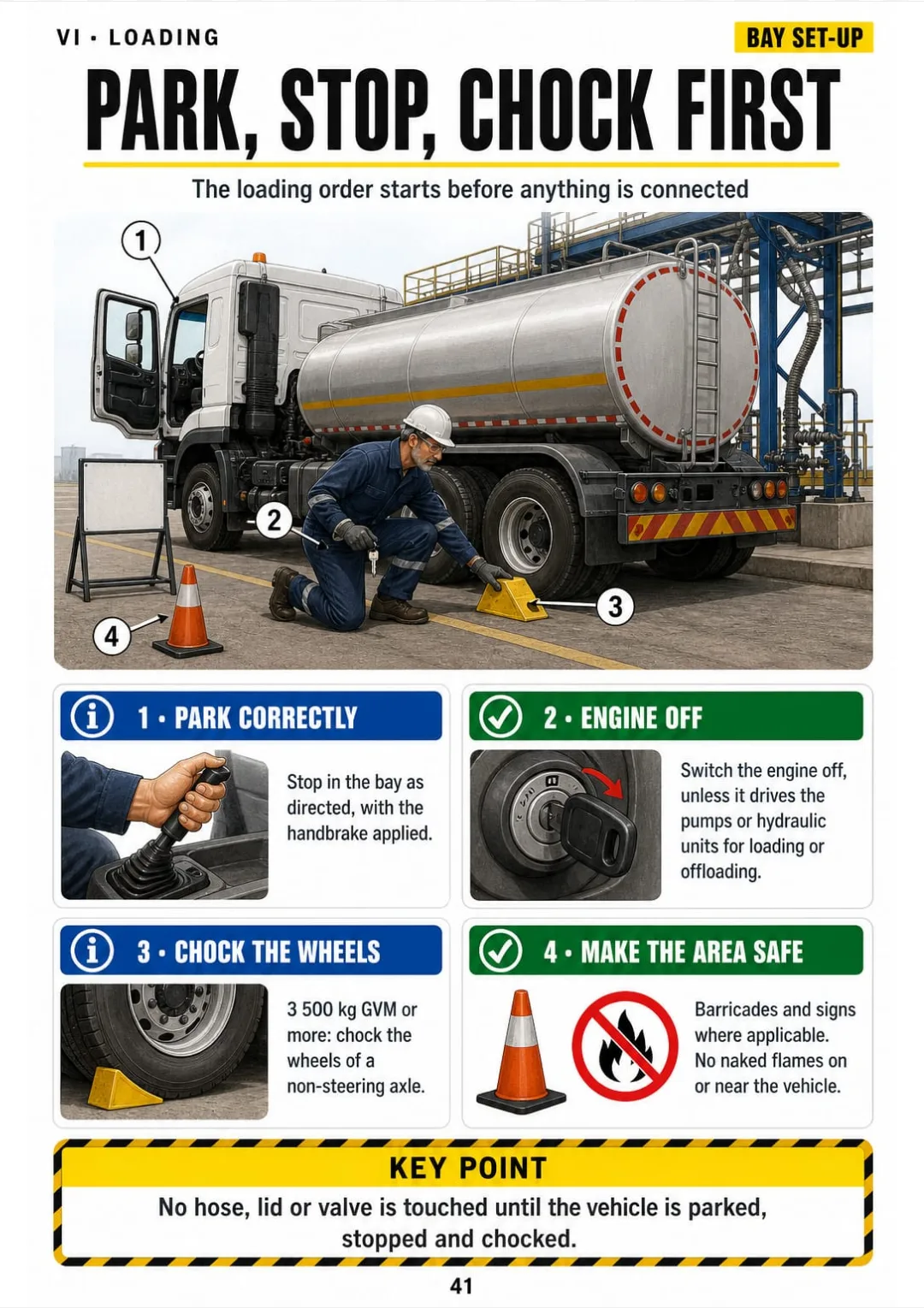
Chock a non-steering axle on vehicles of 3 500 kg GVM or more, engine off unless it drives the pump.
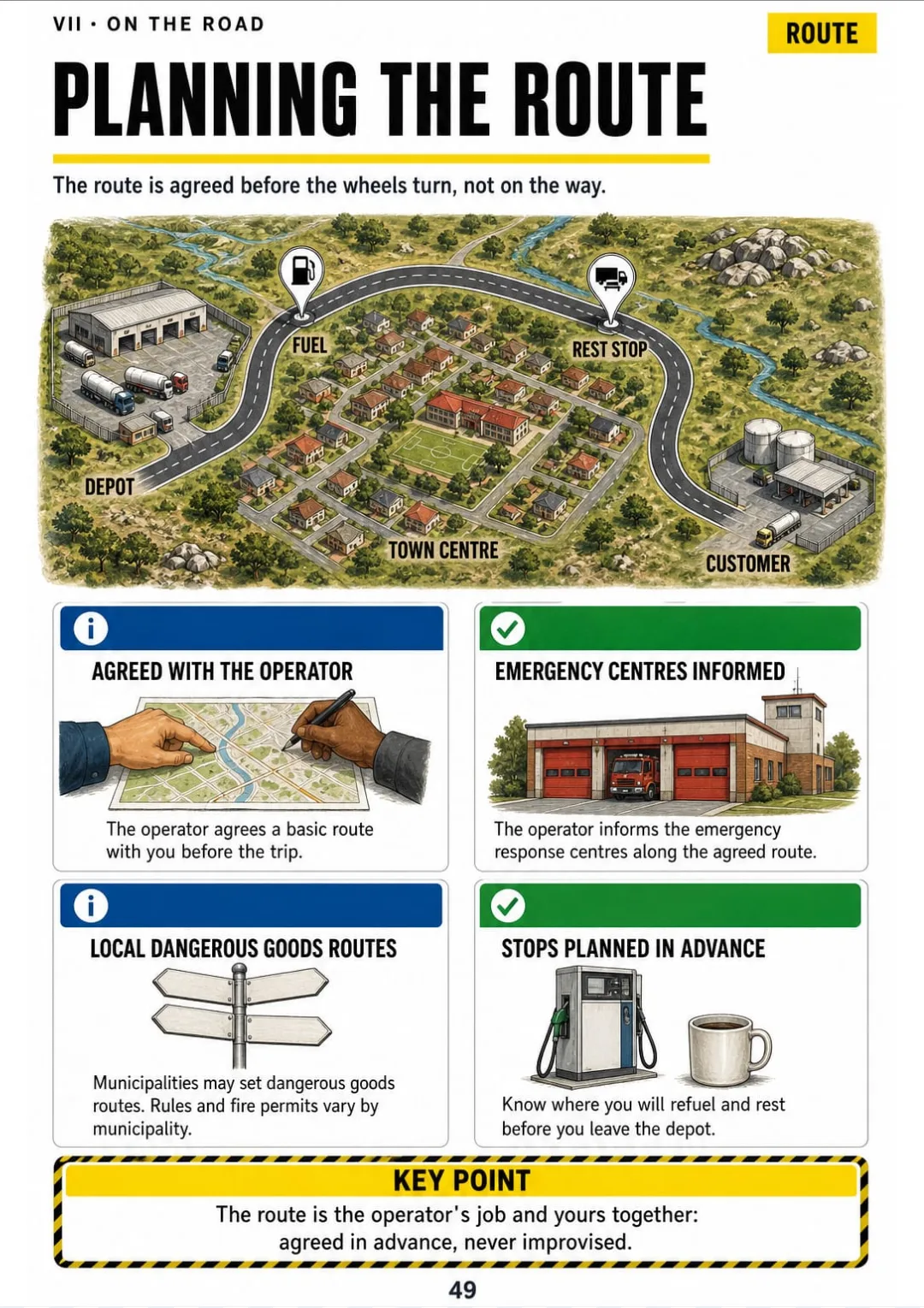
Basic route agreed with the operator; emergency centres along it are informed.
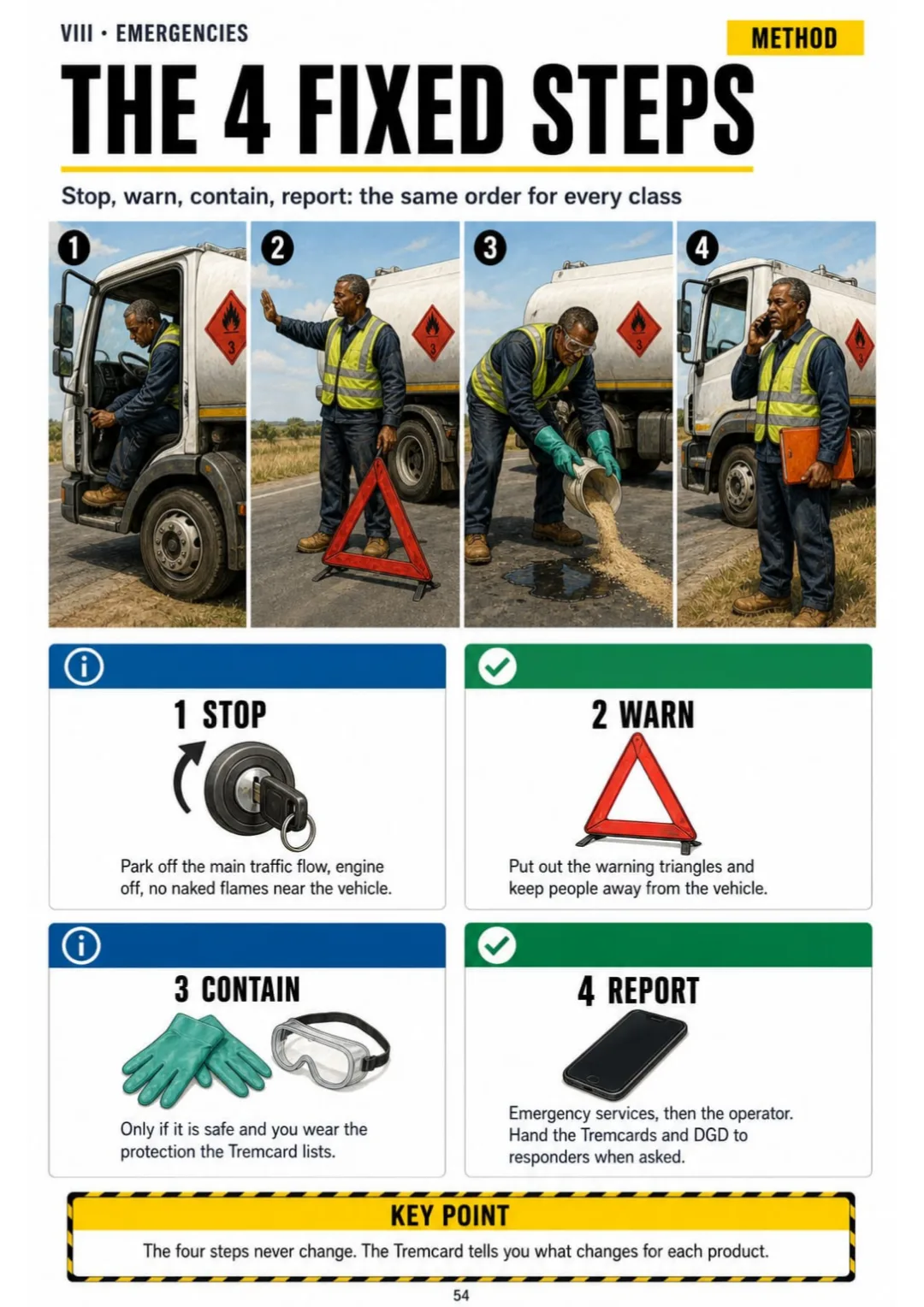
Stop, warn, contain, report: one order for all 9 classes, the Tremcard fills in the details.

Swipe to see more →

These are real pages from the book. The table of contents is the full one: 9 parts and 63 topics.

The Problem Isn't You. It's How It Was Explained.

You're standing behind a loaded tanker and the trainer points at the diamond on the back: what is it telling you? You know you read this last night.

The manual covers it in paragraphs: sizes, borders, symbol, class number, subsidiary hazard. Words about a picture don't stay in your head after a long shift.

Main hazard diamond 250 mm, subsidiary diamond 100 mm, class number in the bottom corner.

In the book, the hazard diamond is one page: the diamond drawn large, every part labelled. Symbol at the top, class number in the bottom corner, 250 mm on the vehicle.

The same goes for the UN number, the vehicle placard, the Tremcard, the segregation pairs and the 4 spill steps: each one has its own page.

Next time you see a diamond on a truck, you know what it says without opening the manual.

COMPARE FOR YOURSELF

The Same Topic, Two Ways to Study It

THIS
  • The manual: line after line
  • UN numbers and placards explained only in words
  • You arrive at the test with doubts
Every dangerous product you carry has a four-digit number from the United Nations list and a shipping name that goes with it. You'll find that number on the paperwork, on the packages and, in many cases, on the placard of the vehicle, and it has to match the product on board. If the product falls under a general entry, its technical name is added in brackets after it. For example, petrol is 1203, diesel is 1202 and LPG is 1075.
FOR THIS
  • The UN number in one drawing
  • The numbers in one box
  • You see it and you get it
Petrol UN 1203, diesel UN 1202, LPG UN 1075: the number that goes on every document
CONTENTS

Take a Look at the 9 Parts and 63 Topics

The job and the licence, the 9 classes, labels and placards, documents on board, vehicle and equipment, loading and segregation, the road, emergencies and revision: 67 pages, all illustrated.

IThe job and the licence · pp. 5-9
  1. What counts as dangerous goods on the road
  2. PrDP category D: what you need
  3. Who is responsible for what
  4. The standards behind your course in one line each
  5. The six ways a load can hurt you
IIThe 9 classes · pp. 10-21
  1. UN number and proper shipping name
  2. Packing groups I, II and III
  3. Class 1: Explosives
  4. Class 2: Gases
  5. Class 3: Flammable liquids
  6. Class 4: Flammable solids and the three divisions
  7. Class 5: Oxidisers and organic peroxides
  8. Class 6: Toxic and infectious substances
  9. Class 7: Radioactive material
  10. Class 8: Corrosives
  11. Class 9: Miscellaneous
  12. Main hazard and subsidiary hazard
IIILabels, placards and markings · pp. 22-28
  1. Anatomy of a hazard diamond
  2. Markings on packages
  3. The vehicle placard, part by part
  4. Where the placards go on a tanker
  5. Placards on a packaged-goods or mixed load
  6. Empty is not clean: placards on an empty tanker
  7. Read the truck from a distance
IVDocuments on board · pp. 29-34
  1. The dangerous goods transport document
  2. What a Tremcard is and why it is in your cab
  3. Reading a Tremcard always in the same order
  4. Tremcard or safety data sheet?
  5. Your own papers
  6. Where the documents live in the cab
VVehicle and equipment · pp. 35-40
  1. Pre-trip walk-around in one circle
  2. Fire extinguishers on board
  3. Emergency kit and PPE
  4. The parts of a road tanker
  5. Ullage: why a tank is never filled to the top
  6. Gas cylinders on a delivery truck
VILoading, offloading and segregation · pp. 41-48
  1. Before the first hose: park, stop, chock
  2. Earth first, disconnect last
  3. Bottom loading in the same order every time
  4. Offloading at a filling station
  5. Securing packaged loads
  6. Segregation: why some loads cannot travel together
  7. The pairs to remember
  8. Food and toxics in the same load
VIIOn the road · pp. 49-53
  1. Planning the route
  2. Parking a loaded vehicle
  3. Ignition sources around the truck
  4. Breakdown: make the scene safe
  5. Heat, hills and rain
VIIIEmergencies: leaks, spills and fire · pp. 54-62
  1. The 4 fixed steps: stop, warn, contain, report
  2. Approach upwind and uphill
  3. Keep people back
  4. A valve that drips at the depot
  5. Containing a spill
  6. Fire on the vehicle: fight or leave
  7. Gas tanker in a fire
  8. First aid on the scene
  9. Reporting the incident
IXRevision for the cab and the test · pp. 63-67
  1. The 9 classes on one page
  2. Placards and documents check
  3. Loading order card
  4. Emergency card: 4 steps
  5. The most frequent mistakes

One Page, One Topic, All Clear

Think of it like this:

You're at the depot, about to load, and the shift supervisor is standing next to you. You need the order: what you do before the first hose goes on.

You open the page and it's drawn: park, stop, chock a non-steering axle, engine off unless it drives the pump, each step numbered in the order you do it.

Daily walk-around: start of the trip and after each overnight stop; air build-up max 12 minutes for a drawing vehicle.

The same with the 9 classes, the vehicle placard, the Tremcard, the segregation pairs and the 4 spill steps: each one on its own page.

Dangerous Goods Driver Illustrated is 9 parts and 63 topics, all drawn, with revision cards for the cab and the test at the end.

What you see drawn, you don't have to memorize.

What's Inside Dangerous Goods Driver Illustrated:

Ipp. 5-9

The job and the licence

What counts as dangerous goods, PrDP category D, who is responsible for what, the standards behind the course and the six ways a load can hurt you.

IIpp. 10-21

The 9 classes

UN number and shipping name, packing groups, each of the 9 classes with its diamond, and main versus subsidiary hazard.

IIIpp. 22-28

Labels, placards and markings

The hazard diamond part by part, package markings, the vehicle placard, where placards go on a tanker or a mixed load, and empty tankers.

IVpp. 29-34

Documents on board

The transport document, the Tremcard read in the same order every time, Tremcard versus safety data sheet, your own papers and where they live in the cab.

Vpp. 35-40

Vehicle and equipment

The walk-around in one circle, extinguishers, emergency kit and PPE, the parts of a road tanker, ullage and gas cylinders.

VIpp. 41-48

Loading, offloading and segregation

Park, stop, chock, earth first, bottom loading, offloading at a filling station, securing packaged loads and the segregation pairs.

VIIpp. 49-53

On the road

Route planning, parking a loaded vehicle, ignition sources, breakdowns, and heat, hills and rain.

VIIIpp. 54-62

Emergencies: leaks, spills and fire

The 4 fixed steps, approaching upwind and uphill, keeping people back, a dripping valve, spills, vehicle fires, gas tankers, first aid and reporting.

IXpp. 63-67

Revision for the cab and the test

The 9 classes on one page, placards and documents check, loading order card, emergency card and the most frequent mistakes.

At the end of the book: Revision cards for the cab and the test, plus the most frequent mistakes on one page.
Plus: 2 Free Books

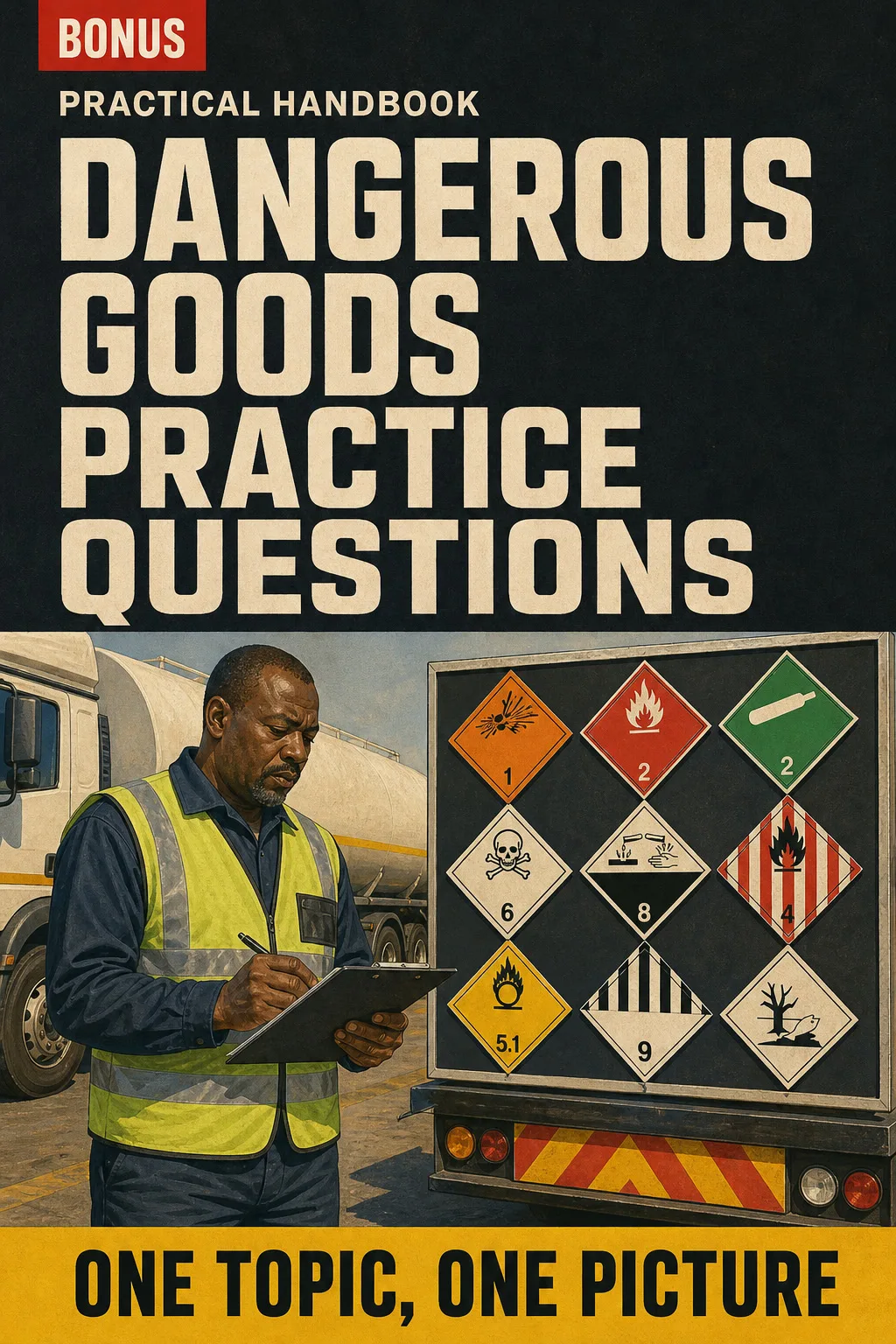
Dangerous Goods Practice Questions

BONUS 1: «Dangerous Goods Practice Questions»

Value on its own: US$ 17.90

Exam-style questions on classes, placards, documents and emergencies, with the answer and the page to revise, so you find your gaps before the course test.

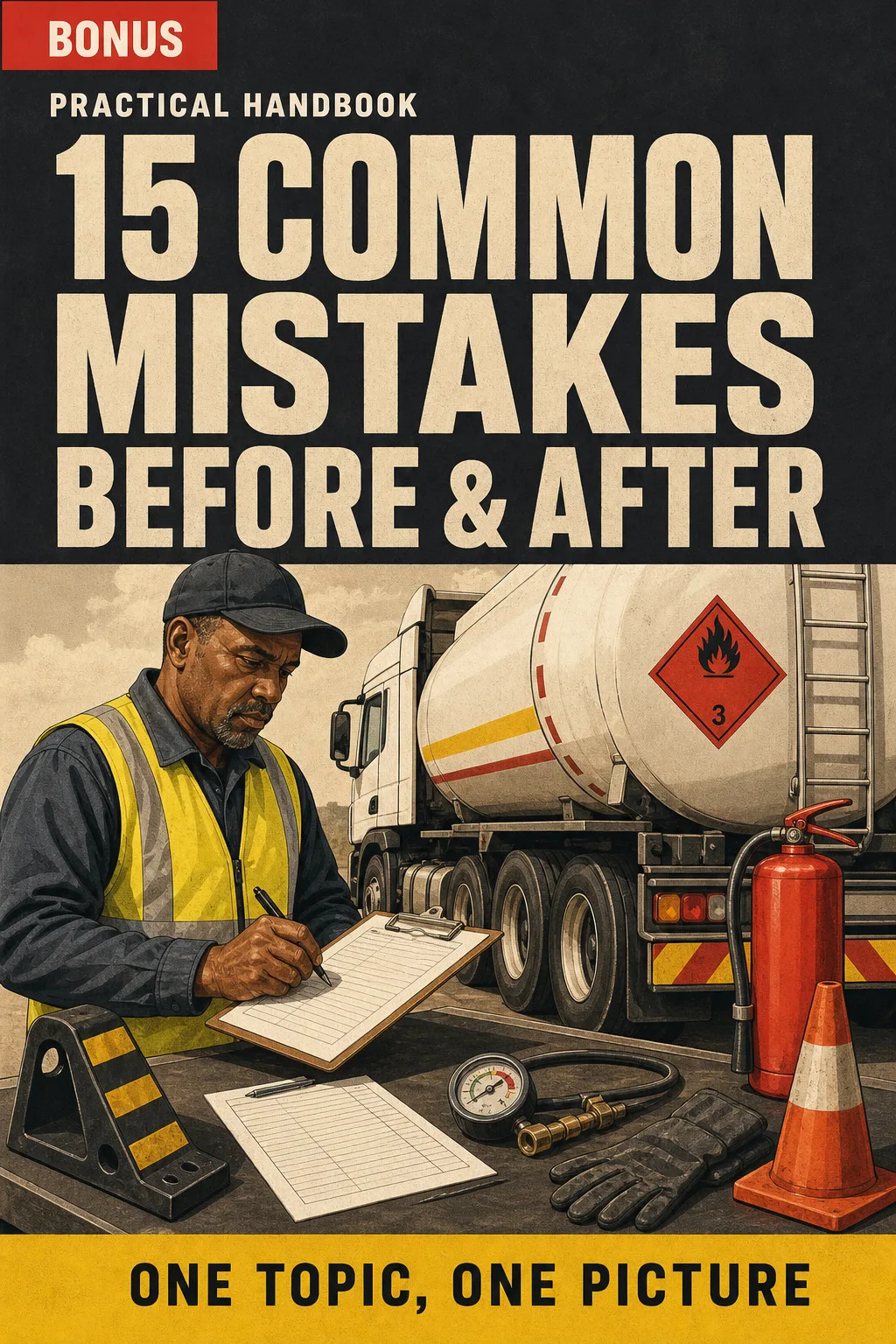
15 Common Mistakes Before & After

BONUS 2: «15 Common Mistakes Before & After»

Value on its own: US$ 14.90

The most frequent mistakes with placards, Tremcards, segregation and earthing, each drawn wrong and right, to revise in ten minutes before a trip or the test.

Dangerous Goods Driver Illustrated with 2 Free Books

  • Dangerous Goods Driver Illustrated: 67 illustrated pagesUS$ 63
  • BONUS 1: Dangerous Goods Practice QuestionsUS$ 17.90
  • BONUS 2: 15 Common Mistakes Before & AfterUS$ 14.90
  • High-resolution PDF to printIncluded
Total value US$ 95.80
YOUR PRICE:
US$ 27
You save US$ 68.80
YES, I WANT DANGEROUS GOODS DRIVER ILLUSTRATED FOR US$ 27

📄 This is a digital PDF book sent to your email: nothing is printed or shipped.

Secure purchaseEncrypted payment30-day guarantee

PDF by email: We email you Dangerous Goods Driver Illustrated as a PDF, together with the two free books. It's a single payment: no installments, no extra charges.

Who This Book Is For

You're moving into dangerous goods

You're moving into dangerous goods

You drive Code 14 and want to move into fuel, gas or chemical loads. See every topic of the course drawn before you even sign up.

Your PrDP renewal is close

Your PrDP renewal is close

Years since you last studied? Each class, placard and document is one page, so you revise in short stops instead of long nights.

You already drive a tanker

You already drive a tanker

Print the pages you need and keep them in the cab: loading order, Tremcard and the 4 spill steps, at a glance.

Everything You Get Today

US$ 95.80US$ 27
YES, I WANT DANGEROUS GOODS DRIVER ILLUSTRATED FOR US$ 27

📄 This is a digital PDF book sent to your email: nothing is printed or shipped.

30DAYS
GUARANTEE

30-Day Guarantee

Try Dangerous Goods Driver Illustrated for 30 days, bonus books included.

We refund everything if the file won't open, if the book isn't what you see here, if you were charged twice or if the email doesn't arrive. Just email us.

You pay once. No subscriptions.

Frequently Asked Questions

Is it for me if I've driven trucks for years and now need category D of the PrDP?

Yes. It's written for working drivers in South Africa, following the National Road Traffic Regulations and the SANS standards. It isn't more text: each topic is one drawn page, from the 9 classes to spills, so you revise what you need without starting from zero.

Where does the content come from?

From the National Road Traffic Act 93 of 1996 and its Regulations (dangerous goods chapter) and the SANS standards: 10228, 10229-1, 10231, 10232-1 and 10232-3. Explained in our own words and drawings.

Is it official material?

No. It's an independent illustrated study book. It isn't issued or endorsed by any authority, standards body or training provider, and it doesn't give you a certificate: the dangerous goods certificate for your PrDP comes from accredited training.

Does it replace the course?

No. You still need accredited dangerous goods training for your PrDP. The book helps you understand and revise what the course covers.

Are the practice questions the ones in the test?

No. They're written for this book to help you find your gaps. They aren't official questions from any test.

When and how does it arrive?

As a PDF by email, to the address you enter at checkout. The 2 bonus books come the same way.

Do I have to pay every month?

No. It's a one-off payment.

Can I have it on paper?

Yes. It's a PDF you can print at home or at a print shop, all of it or just the pages you want in the cab.

How does the refund work?

You have 30 days. We refund everything if the file won't open, if the book isn't what you see on this page, if you were charged twice or if the email doesn't arrive: just email us.

Before You Close This Page

No more rereading with nothing sticking.

Placards and Tremcards: you see them drawn and they make sense.

You get to the test and the depot knowing where everything is.

Drawings make studying faster.

The book is right below.

One-time payment: US$ 27 · Guarantee: 30 days · PDF by email

YES, I WANT DANGEROUS GOODS DRIVER ILLUSTRATED FOR US$ 27

📄 This is a digital PDF book sent to your email: nothing is printed or shipped.